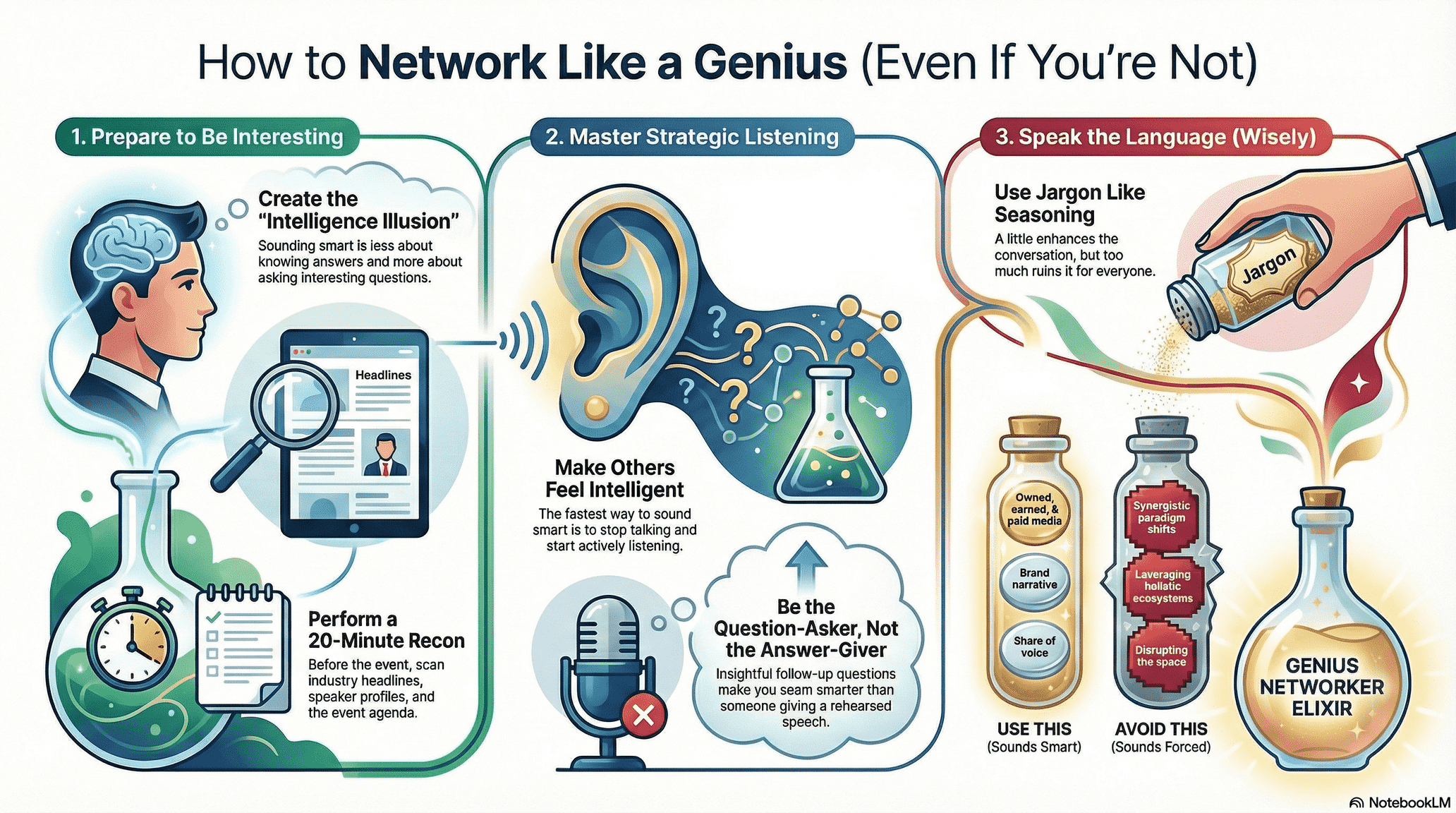

In a previous post, we discussed how you can network and still sound intelligent, but we didn’t finish the full gist. In this post, I have written some extra tips on how you can sound intelligent at networking events.
Have Your Stories Ready (Everyone Loves a Good Story)
Here’s something that will make you instantly more interesting at networking events: stories. Not your elevator pitch (we’ll get to that), but actual stories about work, failure, learning, or weird things that happened.
These don’t have to be dramatic. In fact, the best networking stories are relatable and mildly self-deprecating. They make you seem human and approachable while demonstrating that you’re learning and growing.
Keep a mental file of three types of stories:
The Learning Story: “I just learned the hard way that you should always double-check who’s cc’d on an email. I accidentally sent our entire competitor analysis to a client list that included… a competitor. My manager was surprisingly cool about it, and now I have a three-step email checking system.”
The Success Story: “We just wrapped a campaign where we partnered with a local nonprofit, and the engagement rate was three times higher than our usual content. It really drove home how much people respond to authentic, purpose-driven marketing.”
The Curiosity Story: “I’ve been deep-diving into TikTok analytics lately, and the patterns are wild. The algorithm seems to reward weirdness over polish, which is the opposite of what I learned about traditional PR.”
Notice how each story does multiple things at once: it demonstrates you’re actively working, you’re learning from experience, you’re paying attention to results, and you’re thinking critically about the industry. All of this makes you sound intelligent without you having to claim “I’m intelligent.”
The Story Strategy: Facts tell, but stories sell. A good anecdote about your work will make you more memorable than any list of accomplishments.
Ask Questions That Make You Look Like a Critical Thinker
Not all questions are created equal. Some make you sound curious, and others make you sound like you showed up to a marketing event by accident while looking for the food court.
Questions that make you sound thoughtful:
- “How do you see industry trends affecting client expectations?”
- “What’s the biggest misconception people have about your role?”
- “If you could change one thing about how our industry operates, what would it be?”
- “What’s a skill you wish you’d developed earlier in your career?”
- “How do you stay current with everything changing so fast?”
Questions to avoid:
- “So… what exactly does your company do?” (Google exists, friend)
- “Can you get me a job?” (Networking is not a job vending machine)
- “What’s your ROI on social media?” (too specific for small talk)
- Anything that sounds like you’re trying to pitch them something
The best questions open up interesting conversations rather than dead-ending in one-word answers. They show you’re thinking beyond surface level without putting someone on the spot or making them feel like they’re being interviewed for a podcast they didn’t agree to be on.
The Question Quality Test: If the question could be answered with a quick Google search or a yes/no, it’s probably not interesting enough for a networking conversation.
Know Your Elevator Pitch (But Make It Human)
Ah yes, the dreaded elevator pitch. That 30-second summary of who you are and what you do that somehow needs to be memorable, professional, and interesting while also not sounding like you’re reading from a script you memorized in front of your bathroom mirror at 2 AM (even if you did).
Here’s the structure that actually works for newbies:
[Your role] at [Company] + [What that means in human terms] + [Something interesting or specific]
Instead of: “I’m a junior account executive at Smith Marketing Agency working in digital strategy and brand development.”
Try: “I’m a junior account executive at Smith Marketing, which basically means I help brands figure out how to not be boring on social media. Right now I’m working on a campaign for a sustainable fashion brand, which is teaching me that Gen Z can smell inauthenticity from a mile away.”
See the difference? The second version is conversational, gives people something to respond to, and shows personality. It’s also self-aware about your junior status without being apologetic about it.
The best elevator pitches spark conversation rather than ending it. Give people something to ask about or react to.
The Pitch Reality: Your elevator pitch should sound like something you’d actually say to a human, not like you’re auditioning for a LinkedIn video series.

Read the Room (And Know When to Exit Gracefully)
Here’s a skill that will save you from countless awkward situations: knowing when a conversation has run its course. Nothing makes you seem less intelligent than desperately clinging to a conversation that died five minutes ago while the other person’s eyes dart around looking for an escape route.
Signs a conversation is wrapping up:
- Increasing phone checks
- “Well, I should probably…” (this is the universal signal)
- The energy shifts from engaged to polite
- You’ve both said “Well, anyway…” three times
- Someone else is hovering nearby clearly wanting to join or steal your conversation partner
When you sense this happening, be the one to gracefully exit first. “This has been great—I’m going to grab another drink and let you mingle. Let’s connect on LinkedIn!” Then actually leave. Don’t linger. Don’t pitch something at the last second. Just smile and move on.
Being the person who can read social cues and exit smoothly makes you seem confident and socially intelligent, which is just as valuable as industry knowledge.
The Exit Strategy: Knowing when to end a conversation gracefully is the mark of someone who actually knows how to network, not just someone who knows how to talk.
Follow Up Like a Professional Human
The networking event is over. You’ve collected business cards (or awkwardly exchanged LinkedIn info via phone). You’ve had interesting conversations. You didn’t spill anything on yourself or accidentally insult anyone’s company. Victory!
But the real test of whether you seemed intelligent at the event is what you do next.
Within 48 hours, send a brief, personalized message to the people you actually connected with. Not everyone, just the people you had genuine conversations with.
The formula:
- Reference something specific you discussed
- Add value if possible (an article, a connection, a resource)
- Keep it brief and friendly
- Don’t immediately ask for anything
Example: “Hi Sarah! Really enjoyed chatting about the challenges of measuring brand awareness campaigns at the conference. I came across this article about new attribution modeling techniques and thought of our conversation. Hope your campaign launch goes well!”
This follow-up serves multiple purposes: it reminds them who you are, it demonstrates you were actually listening, and it positions you as someone who adds value to their network. All of which makes you seem thoughtful and intelligent.
The Follow-Up Truth: The smartest thing you said at the networking event means nothing if you don’t follow up. Intelligence without action is just trivia.
Embrace Being New (It’s Actually Your Superpower)
Here’s the final secret, and it’s the most important one: Being new to the industry isn’t a weakness—it’s actually an advantage if you frame it correctly.
You’re not expected to know everything. You’re expected to be curious, eager to learn, and fresh-eyed about the industry. That’s your superpower. Use it.
When someone mentions something you don’t know, don’t panic and pretend you know it. Instead, say: “I haven’t come across that yet—can you explain it?” or “I’m still learning about that area—what’s your take on it?” People love being asked for their expertise, and you’ll learn something valuable.
The people who seem most intelligent at networking events aren’t the ones who know everything—they’re the ones who are genuinely curious about what they don’t know. They ask good questions, listen actively, and follow up thoughtfully. They’re present in conversations rather than mentally rehearsing their next impressive-sounding statement.
You don’t need to be the smartest person in the room. You just need to be the most genuinely interested person in the room. That’s more than enough.
The Newbie Advantage: Your fresh perspective and genuine curiosity are more valuable than you think. Don’t hide them, use them.
The Bottom Line
Sounding intelligent at networking events isn’t about pretending to be someone you’re not. It’s about presenting the most confident, curious, and engaged version of who you already are. It’s about doing your homework, asking good questions, listening actively, and following up thoughtfully.
The more networking events you attend, the easier this gets. The terminology becomes more familiar. The industry trends start making sense. The faces become familiar. One day, you’ll realize you’re no longer faking it—you’ve actually become the knowledgeable professional you were trying to sound like.
Until then, remember: Everyone at that networking event was once exactly where you are now. The person confidently discussing programmatic advertising strategies? They once stood nervously by the snack table wondering if they were holding their wine glass correctly.
The difference between them and you isn’t intelligence. It’s just practice! Your future self, the one confidently networking at industry events and wondering why everyone seems so nervous, will thank you.
I hope you enjoyed reading this far. Join me monthly on my journey into the PR and marketing world, where I discuss challenges, tips, pointers, and wins in the PR & marketing career space. See you soon!
Warm regards,
The PR Chic