
… A Survival Guide for PR and Marketing Newbies Who’d Rather Be Literally Anywhere Else
So you’ve just landed your first job in PR or marketing, and someone has handed you a name badge with your company’s logo on it and told you to “go network.” Congratulations! You’re about to spend the next two hours pretending you understand what “synergistic brand ecosystems” means while desperately trying to remember if you’re supposed to eat the canapés or just hold them decoratively.
Welcome to the networking event, that special circle of professional bliss where everyone seems to know exactly what they’re talking about, and you’re just hoping nobody asks you to explain the difference between earned and paid media (it’s okay, we’ll get to that later).
But here’s the secret that nobody tells newbies: Half the people at these events are just as terrified as you are. They’re just better at hiding it behind industry jargon and confident nodding. The good news? You can learn to do that too. The better news? You can actually become genuinely interesting to talk to in the process.
Let’s turn you from a nervous newbie into someone people actually want to talk to.
Do Your Homework (But Make It Look Effortless)
Picture this: You’re at a marketing conference, and someone mentions they work in influencer marketing. You respond with, “Oh, interesting! Have you noticed how the creator economy is shifting toward micro-influencers, or are brands still chasing the mega-influencers despite the engagement rate drop-off?”
Boom. You just went from “nervous newbie” to “person worth talking to” in one sentence.
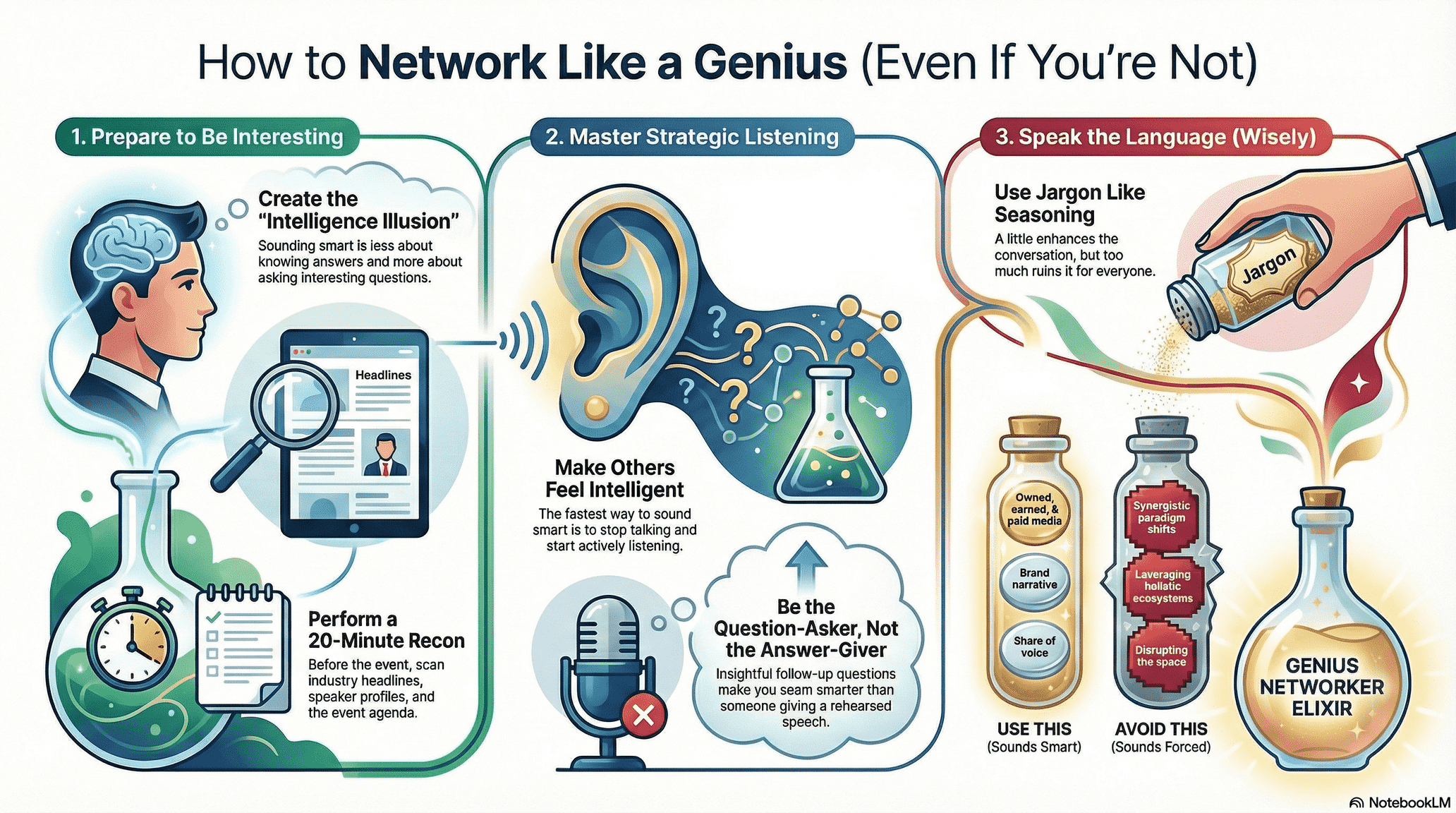
The trick isn’t to memorize everything about PR and marketing (that’s impossible, and frankly, exhausting). The trick is to know just enough about current trends to ask intelligent questions. Before any networking event, spend 20 minutes doing reconnaissance:
- Scan the latest headlines on AdAge, PRWeek, or Marketing Week
- Check what people are arguing about on Marketing Twitter (or X)
- Glance at the LinkedIn profiles of speakers or notable attendees
- Read the event agenda and Google any topics you don’t recognize
You’re not trying to become an expert overnight. You’re trying to collect conversational ammunition. Think of it like studying for a test where all the questions are “What do you think about … (current industry thing)?”
The Intelligence Illusion: Sounding smart is less about knowing everything and more about knowing just enough to ask interesting questions. Questions make you look curious, not clueless.

Master the Art of Strategic Listening
Here’s a plot twist: The fastest way to sound intelligent at networking events is to stop trying to sound intelligent and start making other people feel intelligent instead.
Most people at networking events are waiting for their turn to talk, not actually listening. They’re mentally rehearsing their elevator pitch while you’re mid-sentence. So when you actually pay attention to what someone is saying, like, really listen, you become memorable.
Try this technique: Listen for the thing someone is clearly passionate about, then ask them to tell you more about it. If someone mentions they just launched a campaign, don’t immediately pivot to talking about your work. Instead, ask: “What was the biggest challenge in getting that approved?” or “What response surprised you the most?”
People love talking about their work when they feel like someone genuinely cares. And while they’re talking, you’re learning things you can reference later in the conversation or store away for future networking situations.
Plus, asking thoughtful follow-up questions makes you seem engaged and intelligent without requiring you to be the expert in the room. It’s a win-win, except you’re winning twice.
The Listening Hack: The person asking insightful questions always seems smarter than the person giving rehearsed answers. Be the question-asker.
Build Your “Smart Person” Vocabulary (But Don’t Be Insufferable About It)
Let’s be real: Every industry has its jargon, and PR and marketing have enough buzzwords to fill a small dictionary. The key is learning which terms make you sound knowledgeable and which ones make you sound like you swallowed a business book and are regurgitating it at a cocktail party.
Terms that make you sound smart:
- “Owned, earned, and paid media” (the holy trinity of PR)
- “Thought leadership” (creating content that positions someone as an expert)
- “Brand narrative” (the story a brand tells about itself)
- “Conversion funnel” (the journey from awareness to purchase)
- “Share of voice” (how much your brand is mentioned compared to competitors)
Terms that make you sound like you’re trying too hard:
- “Synergistic paradigm shifts”
- “Leveraging holistic ecosystems”
- “Disrupting the space” (unless you actually are)
- “Growth hacking” (people are tired of hearing this)
- Literally anything with “blockchain” or “Web3” unless you’re at a tech conference
The trick is to use industry terms naturally, not like you’re checking boxes on a buzzword bingo card. If you can’t explain a concept in simple terms, you probably don’t understand it well enough to use the fancy terminology yet, and that’s okay! You’re new. Everyone expects you to be learning.
The Vocabulary Rule: Use industry terms like seasoning! A little enhances the conversation, but too much ruins the dish entirely.
Sounding intelligent at networking events isn’t about pretending to be the smartest in the room; it’s about being the most curious, the most engaged, and the most human.
Ask questions that spark real conversation, share insights with warmth, and remember: confidence doesn’t come from knowing everything, it comes from knowing yourself!
Ready for part 2? Read more on how to crush these networking events.
I hope you enjoyed reading this far. Join me monthly on my journey into the PR and marketing world, where I discuss challenges, tips, pointers, and wins in the PR & marketing career space. See you soon!
Warm regards,
The PR Chic



One thought on “How to Sound Intelligent at Networking Events (Without Actually Being a Genius) – Part 1”